
Writing the Body
Écriture Féminine can be translated as feminine writing but people also say, writing the body. Born in France, this experimental form of writing is the child of Hélène Cixous, Luce Irigaray, Catherine Clément, and Julia Kristeva, who say that language, laws, and norms slouch in favor of men.
In The Laugh of the Medusa, Hélène Cixous speaks of female oppression from the phallogocentric structures inherent in language. Meaning, in all cultural discourse, all signs, in all texts, women are silenced, backed into a corner, told their nature, their sex is an abyss, a mysterious and scary dark room. They say it’s an unexplored, but yet claimed country. They say it is not our own.
“Woman must write herself: must write about women and bring women to writing, from which they have been driven away as violently as from their bodies – for the same reasons, by the same law, with the same fatal goal. Woman must put herself into the text – as into the world – as into history – by her own movement.”
Hélène Cixous. The Laugh of the Medusa.
Écriture Féminine is of course the grandchild of the Post-Structuralists, namely the Postmodernist philosopher, Jacques Derrida, and famed psychoanalyst, Jacques Lacan.
Derrida’s concept of Différance (meaning both different and deferral) says that language and meaning have no point of origin and no end. Meaning is always the product of the difference between two signs.
The Sign is the marriage of the Signifier and the Signified.
The Signifier is the word – the representation – that describes the thing.
The Signified is the thing itself.
So, an apple would be the thing, but the word “apple” would be the signifier. This issue is famously discussed in Magritte’s painting, The Treachery of Images.
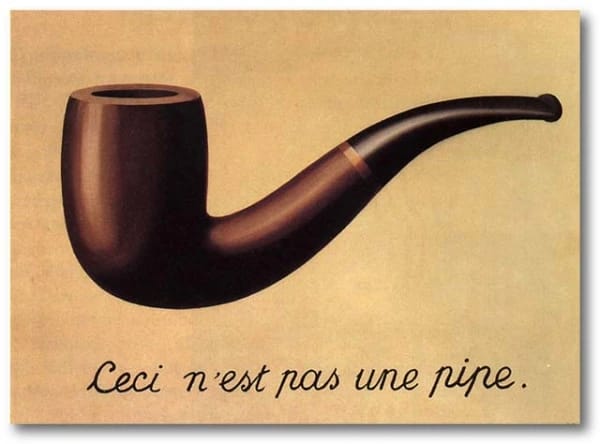
I could go on and on about the pipe-ness of a pipe, and how when someone says the word “pipe” what appears in everyone’s head is specific and generic and different, but, roughly, we all come up with something that kind of looks like that. Unless, of course, you’re talking about a different pipe.
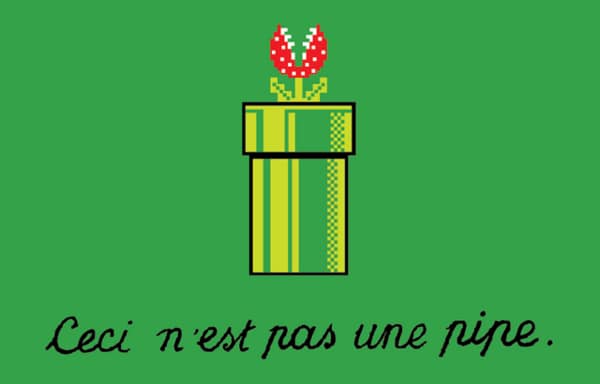
This is what is meant by the slipperiness of language, meaning is endlessly deferred. Like Jiji and her story of two tragic lovers: the signifier and the signified. Aching to be together yet doomed to remain apart. (Jiji. Lily Robert-Foley.)
Western philosophy is obsessed with the elusive and irresistible search for Truth, or Logos. Hence, logocentricism. Its structures are organized through a series of binary oppositions: Man/Woman; Light/Dark; Dry/Wet. (More simply: A/-A.) The first term is desirable, the other shunned, disgusting, other.
The shunned figures, the marginalized figures, the veils of philosophical discourse, the shadows, the enigmas, figurative language itself, are either victimized, or can become fertile ground to resist the Logos, the One, the Light, Truth, the phallus, etc.
Meaning, existence as other is resistance.
Logocentrism assumes that speech exists before writing, therefore, it is the primal and full form of expression. This would then assume that writing would be a supplement to speech, which then assumes that something is lacking in speech.
Derrida argues that speech itself can never manifest Truth directly. That speech, like writing, is structured through difference between the signifier and the sign. Language, the relation of signifiers to signified, can never be an exact science. Nor can it ever be complete.
Language, that word, its flowery permutations, its acrobatic semiotics, changes from person to person. Wittgenstein says it’s impossible to empty the contents of your mind into someone else’s. Meaning, we cannot create an exact duplicate of the pictures inside your brain, for someone else to see, devour, understand, replicate.
So we rely on words. Words, Hamlet points out, are just words, words, words. They are not actions, they are not the things themselves. They are a piece of clothing an idea wears so one person can say something to another.
“No actual language could achieve the simultaneity of signifier and signified, an idealization that is a consequence of the way in which Platonism and Christianity characterized the divine.”
Vincent B. Leitch. The Norton Anthology of Critical Theory.
The effect of this emphasis on the never-ending process of Différance is to settle the binary oppositions that are so important to Structuralism by demonstrating that one element (male as opposed to female; white as opposed to black) is always dominant and that they are inherently unstable because the implicit hierarchy can always theoretically be subverted.



Structuralism analyzes the importance of binary oppositions. And now through Derrida, Cixous, and other Post-Structuralists, the obscured ideas, the veils, the dark, infinite spaces, are also being touched on, thought through, and transformed.
Cixous defines Écriture Féminine as a uniquely feminine style of writing characterized by disruptions in the text, such as gaps, silences, puns, new images, and so on and so forth.
It is a writing practice outside of the masculine economy of patriarchal discourse.
“In women’s speech, as in their writing, that element which never stops resonating, which, once we’ve been premeated by it, profoundly and imperceptibly touched by it, retains the power of moving us – that element is the song: first music from the first voice of love which is alive in every woman. Why this privileged relationship with the voice? Because no woman stockpiles as many defenses four countering the drives as does a man. You don’t build walls around yourself, you don’t forgo pleasure as ‘wisely’ as he. Even if phallic mystification has generally contaminated good relationships, a woman is never far from ‘mother’ (I mean outside her role functions: the ‘mother’ as nonname and as source of goods.) There is always within her at least a little of that good mother’s milk. She writes in white ink.”
Hélène Cixous. The Laugh of the Medusa.
Like Juila Kristeva’s Semiotic, the pre-linguistic, pre-mirror stage of infancy when the child thinks she is still one with the mother. The intimacy of intuition, the coos, the babble, the kisses.
Cixous says that Écriture Féminine is born of the repressed mouths, both of them, woman’s sects.
Écriture Féminine is about multiplicity, and forsaking once and for all the idea that woman is simply Not Man, meaning, a castrated man.
It’s A/B.
Not A/-A.
So what about women’s writing? What will it do?
Cixous urges women to steal their voices back from men, to ignite their mouths, impregnate their words, and soar through themselves, soar above, on their own, without the phallogo-structures of men.
To do this, women must shirk the masculine tongue, the father tongue.
Women’s writing doesn’t have to be, shouldn’t be, meaning, isn’t contained, controlled, or corsetted.
“To fly/steal is woman’s gesture, to steal into language to make it fly,” she says, it is impossible to define a standardized feminine practice of writing, and this is an impossibility that will remain, for this practice can never be theorized, enclosed, encoded, or coded – which doesn’t mean that it doesn’t exist. But it will always surpass the discourse that regulates the phallocentric system because it moves like guerilla warfare inside the system.
“Cixous speaks positively and optimistically about women’s ability to reclaim their right to speak and write in a feminine style. She explains that to be effective, this style must take on an unconventional form, ‘sweeping away syntax, breaking from the famous thread which acts for men as a surrogate umbilical cord.’ By abandoning the linear and orderly characteristics associated with traditional masculine style, Cixous uses the phallocentric language to her advantage. She acknowledges phallocentrism and then, through contradictions, she uncovers the inherent shortcomings. This inadequacy is based upon the realization that Cixous is not able to say exactly what she would like using a masculine discourse. Because Cixous does not have the option of speaking though a feminine discourse, she is forced to use alternative techniques in order to relay a direct and accurate meaning with a masculine language.”
Medusa’s Orgasm.
To achieve this, Cixous uses Medusa, one of the three Gorgon sisters, the one with the strands of hissing snakes for hair, the unlucky girl cursed by Athena to be so ugly, so horrible, that her very gaze will turn men to stone. In a battle with Perseus, Zeus’s clever child uses his own shield to murder, to decapitate the hideouslovely Gorgon.
As such, Medusa has become a feminist icon. Raped, cursed, and blamed for every bit of her suffering, she is a female fantasy of revenge, stoning every stupid boy creature who comes close enough to dare. She’s seen enough, been through enough, and now she’s ready to write, to turn her words to stone and make them stay.

Much like how psychoanalysis draws on myth and religion, Écriture Féminine draws on deconstruction and elements of Lacanian theory (both Cixous and Irigaray worked closely with Lacan) to weave texts of extreme complexity. Theoretical fictions, they’re called because they flood the moat between theory and fiction.
Psychoanalysis was of course founded by Sigmund Freud and it employs theories and methods to delve into one’s unconscious: repressed thoughts and experiences, suppressed emotions and latent desires.
One day, Freud just decides clitoral activity is masculine, making vaginal activity passive. Meaning, woman’s erogenous zones never amount to anything but a feeble clitoris-sex that can’t hold a candle to the noble phallic organ, or a hole-envelope that serves to sheathe and massage the penis in intercourse: a non-sex therefore, a mere masculine organ turned back upon itself. Hence, Irigaray will say, self-embracing.
He wrote an essay on Medusa, on decapitation and castration, on her visage, both terrifying and allluring. Freud says that when a little boy faces a vagina for the first time he realizes that the possession of his penis cannot be taken for granted. His mother’s blank vagina, her endlessly not-penis presents itself as threatening. Thus, woman gives birth to castration anxiety. Freud also says Medusa’s face, her snake-wriggling hair, is a vagina and the snakes are her collection of dicks. Being turned to stone, of course, is also castrating (powerlessness, to make passive, to make a woman), as well as exciting, a form of arousal. His gaze, the gaze upon Medusa, upon woman, is so powerful, that the viewer is transformed, suffers a mini-death, an orgasm. Is rendered motionless by her figure, her form, her beauty.
But this is all to assume that woman is a castrated man, that she suffers penis envy, and requires either a deep dicking or a child to feel full, complete.
Cixous says men say that there are two unrepresentable things: death and vaginas. Ergo, they’re the same! Men need to fear women, they need to fear vaginas.
[Kenophobia. Apeirophobia. Thalassophobia. Menophobia. Kolpophobia. Gynophobia.]
Medusa is simply a manifestation of man’s fear of large empty spaces, infinity, the sea, menstruation, vaginas, women.
This is why Cixous transforms Medusa. She must revise the notion of femininity itself.
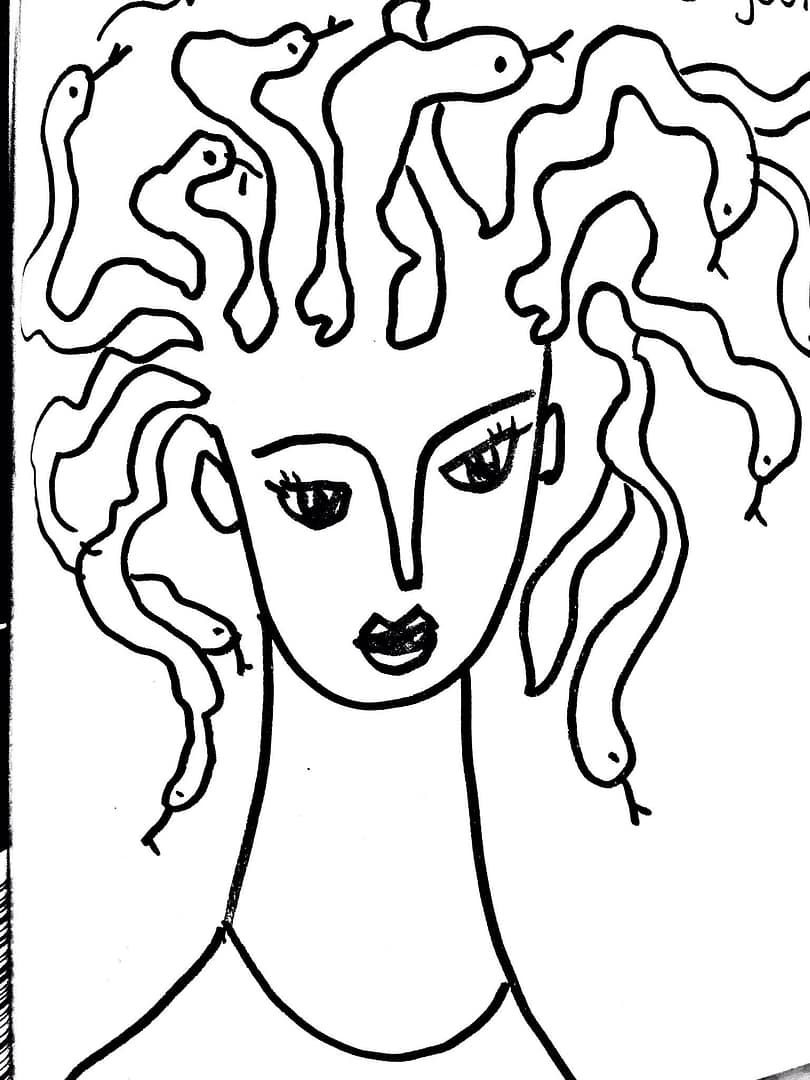
“Wouldn’t the worst be, isn’t the worst, in truth, that women aren’t castrated, that they have only to stop listening to the Sirens (for the Sirens were men) for history to change its meaning? You only have to look at the Medusa straight on to see her. And she’s not deadly. She’s beautiful and she’s laughing.”
Hélène Cixous. The Laugh of the Medusa.
Ha, Luce Irigaray laughs, women’s writing doesn’t draw from the monolothic phallus, but upon the diversity, fluidity, and multiple possibilities inherent in the structure and functions of female sexual experiences. She says that women have been traditionally associated with matter and nature to the expense of a female subject position.
So in agreement with Lacan, she sees that one must enter language/culture in order to be a subject. However, as language excludes women from an active subject position, language itself should change. As opposed to some workaround with the inclusion of women in the current form of subjectivity, Irigaray wants there to be more than one subject position in language.
As we’re very far as a culture from anything like that, in the meantime, just write.
“Write,” Cixous writes, demands.
Write, write, write.
“It is by writing, from and toward women, and by taking up the challenge of speech which has been governed by the phallus, that women will confirm that is, in a place other than that which is reserved in and by the symbolic, that is, in a place other than silence.”
Ibid.
For Lacan, the unconscious is structured like language. Lacan has three orders of consciousness. First, is the Imaginary. It’s the prelinguistic, pre-Oedipal phase when a baby looks at herself in the mirror for the first time and identifies with the image reflected back in the mirror. The child is oblivious to dominant power operations which will separate her from Mom. Second, is the Symbolic order where the child is introduced to the Father who introduces the phallus, the Master Signifier, the center of the Symbolic order. The Father also sets the rules and norms working in language. The child has to let go of the Mother and set out to acquire the concepts of language. And lastly, is the Real, which is beyond the Symbolic, but not opposite of the Imaginary. The Real order is as incomprehensible as language is unable to define the experience.
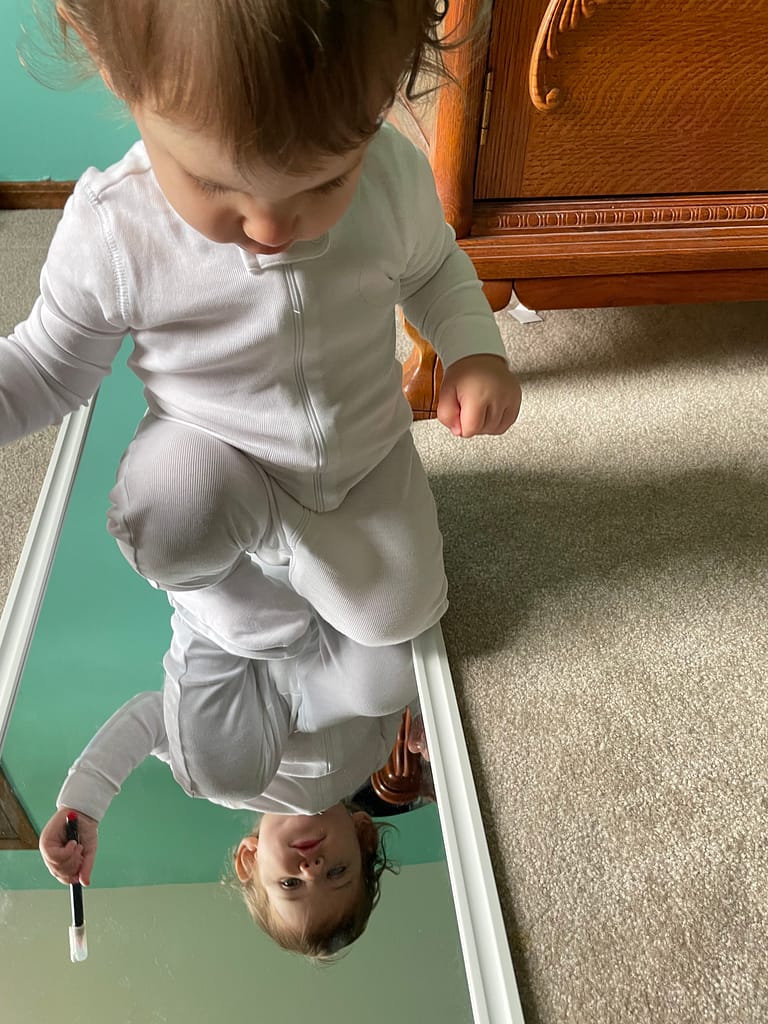
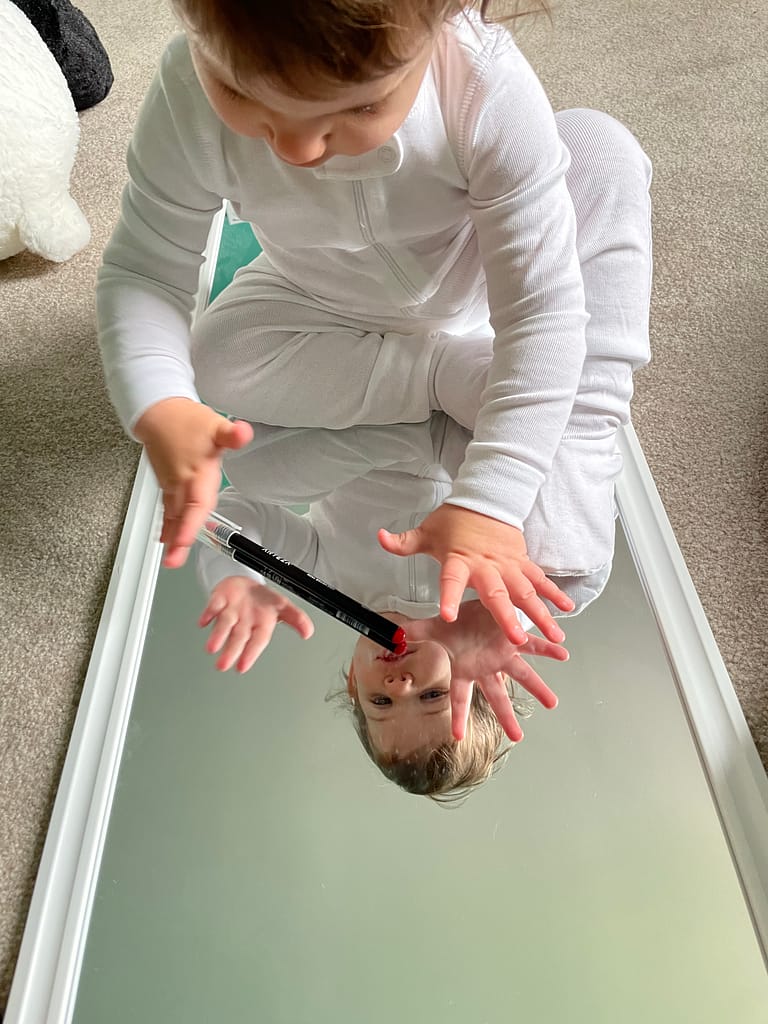
Écriture Féminine language originates in the Mother before the child has acquired the male-centered verbal language. The pre-linguistic and unconscious potentiality manifests itself in literary texts, which are to abolish all repressions, which will undermine and subvert all significations and logic, freeing women from the constraints of phallocentric language, which then ultimately opens writing into a joyous freeplay of meanings.
Kristeva’s Semiotic (from the Greek “semeion” meaning distinctive mark or trace or sign) is contrasted with the Symbolic. The Semiotic is a dimension of language arising from the continued contact with the maternal body that is suppressed by the Symbolic. This relation to the primal mother is a pre-linguistic level that exists prior to or beneath the logical and grammatical structures of the Symbolic, implying that the unconscious is structured not like a language, but like the archaic and preverbal traces of a narcissistic relationship with the Mother.
At the cultural level, the Semiotic preserves and expresses a multifarious libidinal desire that subverts the Symbolic law.
Écriture Féminine, therefore, is poetic and avant-garde. Its texts are characterized by their multiple or polysemic meanings and their subversion of grammar and syntax. The Semiotic represents a challenge to the Father because it remains in contact with the maternal and female element, thus disrupting the Symbolic and threatening to unleash chaos where there is order. The Semiotic threatens to flood the city with all of her lady goo.
Even so, Cixous still situates Écriture Féminine in the realm of the Real. But it takes the form of the expression of the inexpressible and can only be arrived at via experiment and play.
As such, Écriture Féminine plays with the concept of jouissance, French for enjoyment, but also orgasm, as “jouir” means to come. Kristeva, though, makes a distinction between a phallic jouissance – which mobilizes the clitoris and involves competition and identification with the symbolic power of the male partner – and female jouissance that involves the whole of the body and the whole of psychical space.
The focus on the body, and especially the maternal body, has often provoked the criticism that Écriture Féminine can trap itself into an essentialism that reduces femininity to biology. The criticism is countered by the claim that Écriture Féminine is not a feature of an ascribed or fixed gender, but rather a subjective position that can be adopted by women and men alike.
* Cixous said Shakespeare and Joyce wrote excellent Écriture Féminine.
So what about women’s writing? What will it do?
That’s up to you.
Now, go play.


Editing Services
Serving: St. Charles | Geneva | Batavia | Elburn | Galena | Dubuque | Peosta
(630) 567-5410
Cathy@cathyborders.com